Conflict of interest (whether actual, perceived or potential) is one of the more common yet underestimated risks facing Australian organisations today. When personal interests intersect with professional responsibilities, trust can be eroded, and the fairness and integrity of decisions can come into question. Even if no wrongdoing has occurred, situations like these can damage an organisation - raising transparency concerns and eroding trust.
Australian integrity agencies have long recognised conflict of interest as a significant source of fraud and corruption risk. These risks arise in many areas, including procurement, recruitment, and regulatory decision-making. For public-sector organisations, the stakes are higher than most. Decisions are made with public money, under public scrutiny, and subject to formal accountability obligations under frameworks like the Commonwealth Public Governance, Performance and Accountability (PGPA) Act, the APS Code of Conduct, and their state and territory equivalents.
Understanding how conflicts of interest arise and how they should be managed, is critical for protecting your organisation’s integrity. Engaging an independent probity advisor (during an event) or workplace investigator when a suspicion or allegation of Conflict of Interest arises are effective ways to ensure that conflicts of interest are addressed fairly and with appropriate oversight.
Contact Centium to discuss how an independent investigation can protect your process and people
A conflict of interest (whether actual, perceived or potential) occurs when a personal interest affects, or could be seen to affect, a person’s ability to make fair and unbiased decisions at work. This could involve financial interests, personal relationships, or outside work that may conflict with their responsibilities at work.
If not managed properly, conflicts of interest can lead to:
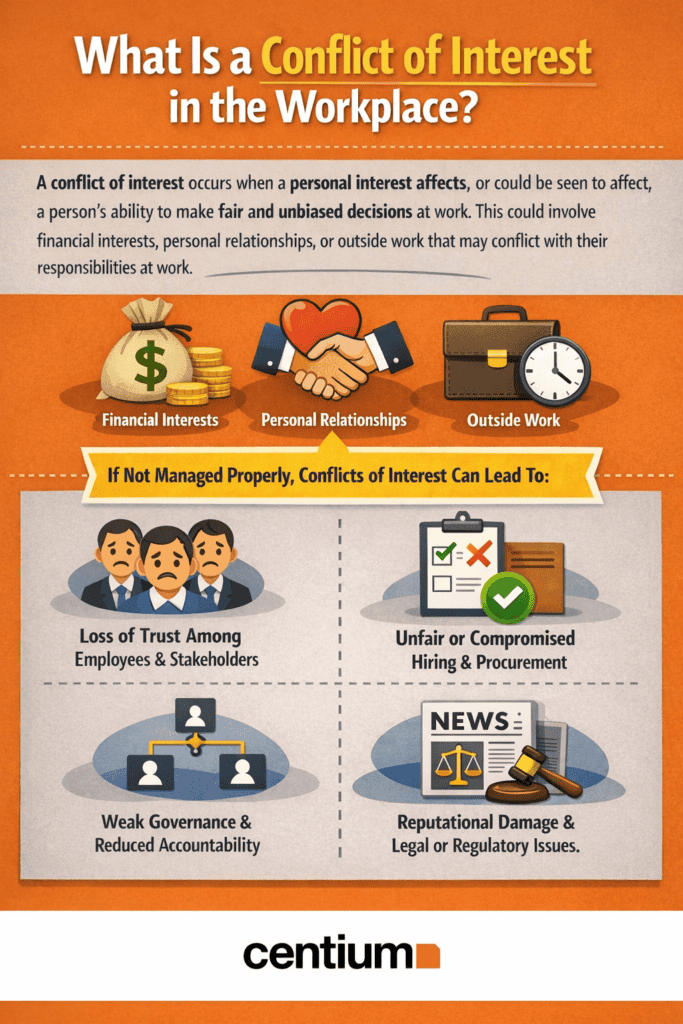
Conflicts of interest can create significant governance risks if not properly managed.
Key risks include:
These risks are particularly serious in environments involving public funds including grants, procurement, or regulatory decisions.
Take the recent scrutiny of aged care audits in Australia, for example. More than 500 actual, perceived, and potential conflicts of interest were discovered by consultancy firms conducting assessments. While not all cases involved misconduct, the scale of these conflicts led to public scrutiny that could have been largely avoided.
Issues like this don't always start with ill intent. It often starts with gaps in processes and unclear workplace policies. This is why clear governance frameworks, such as separation of duties, transparent disclosure requirements, and independent oversight, are very important.
Effective controls can help reduce risk and ensure decisions remain fair and defensible.
Organisations should establish formal disclosure protocols that require individuals to declare conflicts as they arise. Maintaining a conflict register supports transparency, tracking, and managing risks.
Where a conflict exists, if defensible management of the conflict is not practicable, the individual should be removed from the relevant decision-making process to protect the integrity of the decision and the individual from scrutiny.
Robust governance frameworks are essential. This includes clear conflict-of-interest policies, separation of duties, and appropriate oversight.
Independent investigations apply structured processes to ensure conflicts of interest are assessed fairly.
Assessment, negotiation, and oversight roles are kept strictly separate, ensuring no single individual holds control over multiple stages of the decision-making process.
Investigations follow risk-based and evidence-driven methods. This supports fair, justified outcomes.
During workplace investigations, strict protocols to manage sensitive information are adhered to. This reduces the risk of breaches and protects the integrity of the investigation. This may include controlled access to information and the secure storage of documents in secure systems.
Managing conflicts isn't a one-time exercise. Registers need to be actively maintained, with disclosures tracked and reviewed on an ongoing basis. This is particularly important in long-running procurements or projects where the risk environment can change over time. Centium can assist clients in this regard with wide-ranging annual or biannual data analytics checks of possible conflicting interests of key employees and board members.
Conflict-of Interest matters can be difficult to assess internally. Centium conducts independent workplace investigations with a strong grounding in probity and governance.
The Centium team brings experience across state and local government, health, and not-for-profit sectors, as well as other complex environments where accountability and fairness are critical. Centium takes a structured and impartial approach to help organisations address conflicts of interest confidently.
For organisations dealing with sensitive workplace matters, having an experienced, independent investigator is essential.
Some conflict-of-interest situations simply cannot be resolved through internal processes alone. Where concerns are serious or involve senior staff or decision-makers, an independent investigation may be necessary to ensure the matter is handled with integrity.
This is particularly important in situations involving:
An independent investigator significantly reduces the risk of bias and role conflict in these situations while ensuring the process is well-documented and defensible.
Conflicts of interest are typically grouped into three categories: actual, perceived, and potential. Each presents a different level of risk and should be managed appropriately.
An actual conflict exists when a personal interest directly influences a work decision. For example, approving a contract with a supplier in which the decision-maker has a financial stake.
A perceived conflict arises when a situation appears problematic, even if no actual conflict exists. For example, a manager makes a decision that benefits someone with whom they have a personal relationship, even if the decision is justified.
The issue here is that the perception of bias can be damaging in itself, particularly when public confidence in the process is at stake.
A potential conflict of interest exists where a personal interest could develop into a conflict in the future if not identified and managed early. For example, a team member is about to join a project where a company owned by a family member may submit a tender.
Each type requires a different response. It is important for organisations to have clear processes in place to identify and manage actual, perceived, and potential conflicts.
There are many situations in which conflicts of interest can arise. Common examples include:
These situations don’t automatically signal misconduct, but if left unmanaged, they can affect outcomes - or create a perception of bias that could be difficult to reverse.
In some cases, conflicts of interest have contributed to high-profile governance failures, which is why clear oversight and independent review are critical.
Yes, an employer can terminate an employee for a conflict of interest, depending on how serious it is, whether it has been disclosed, and whether it breaches organisation policy or involves misconduct.
The consequences can vary depending on the circumstances. This may include loss of trust, poor decision-making, reputational damage, and legal or regulatory issues. In the workplace, they may also result in removal from a process, a formal investigation, disciplinary action or termination.
