Author: Phil O'Toole
Managing Partner
From 17 November 2025, the revised Commonwealth Procurement Rules (CPRs) have reshaped how Australian Government entities approach procurement, particularly through panels like the Management Advisory Services (MAS) panel.
The changes place particular focus on engaging Australian-owned small and medium enterprises (SMEs), giving them priority in lower-value work and embedding stronger ethical considerations into value-for-money assessments.
As a senior procurement, commercial, or program leader, understanding these changes is key to maintaining CPR compliance. They also create practical opportunities to leverage Australian SMEs more effectively and deliver better program outcomes.
The CPRs provide the mandatory framework governing the procurement of goods and services by non-corporate Commonwealth entities. Issued by the Australian Government, the CPRs are designed to ensure procurement is conducted in a way that delivers genuine value for money while remaining ethical and accountable. The CPRs set out the core procurement principles, processes, and requirements that must be followed throughout the entire procurement lifecycle. From planning and market engagement through to contract management.
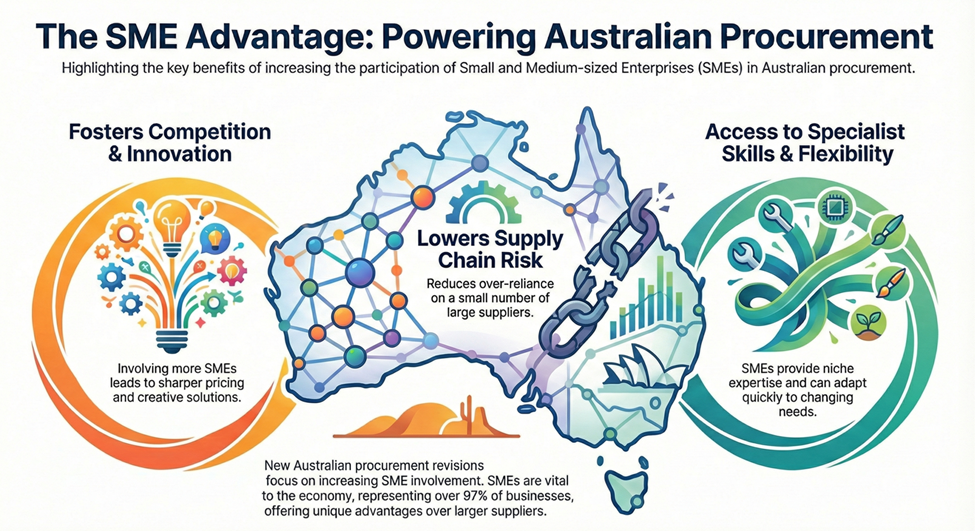
Why do the new revisions focus on SMEs?
Australian SMEs account for approximately 97.2% of all businesses and contribute hundreds of billions to the economy each year. They support jobs, drive innovation, and bolster regional communities.
Strengthening the participation of Australian SMEs will strengthen the economy further by keeping government spending within Australia.
For procurement and program leaders, increasing SME participation is not only a policy requirement but also a practical and strategic priority.
For procurement leaders, it helps make procurement easier and more effective by:
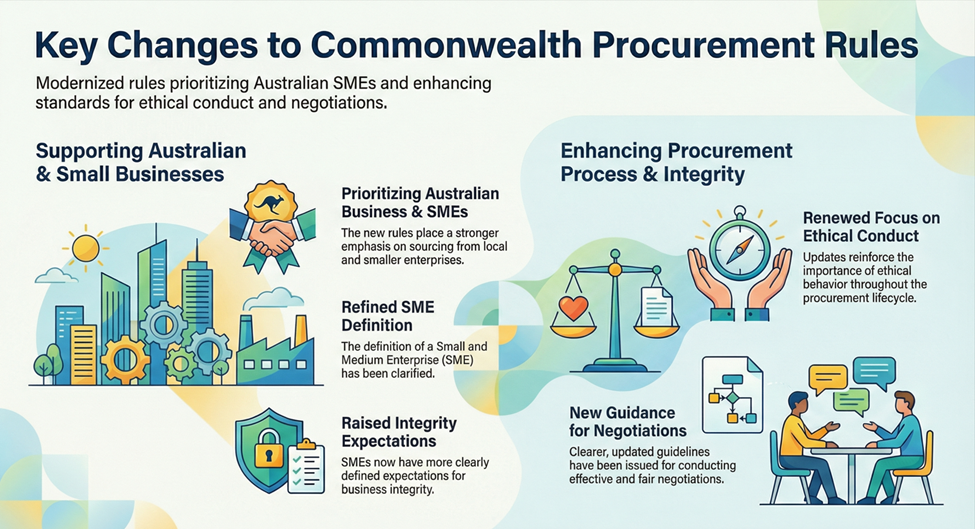
The updated CPRs (effective from 17 November 2025) introduced several changes that directly affect how government entities approach procurement.
One of the most practical changes is how suppliers are invited to participate in lower-value procurements.
The key changes are:
Together, these changes are intended to provide guidance for engaging Australian-owned SMEs in lower-value procurements.
The updated CPRs strengthen how SME eligibility is assessed. SME eligibility is now assessed based on how a business actually operates, not just its legal structure.
This change is designed to prevent businesses from structuring arrangements that, in the past, would have qualified them as SMEs on paper but did not reflect their practical operations.
This helps to ensure that SME-only procurement pathways are accessed by genuine SMEs.
The updated Commonwealth Procurement Rules strengthen the consideration of ethical conduct as part of value-for-money.
Government entities are now expected to actively consider how a supplier operates, and procurement decisions must consider whether suppliers meet minimum standards in areas including:
These changes help to reduce risk and protect integrity in Commonwealth procurement. These updated rules help ensure that government contracts are awarded to suppliers that operate ethically and aren’t just the cheapest on paper.
The updated CPRs introduce clearer guidance on how officials may negotiate with tenderers while remaining compliant.
The clarification is intended to support more effective procurement outcomes, as complex engagements can legally be refined through discussion. Negotiations are now considered a legitimate part of the procurement process.
For senior officials, this places greater emphasis on ensuring evaluation plans, RFQ documentation, and delegations clearly allow for negotiation when required. This is particularly relevant for MAS engagements, where iterative solution development is required.
Example: Negotiation in Practice
An agency issues a RFQ under the Management Advisory Services Panel for a strategic review with an expected value of $115,000. Two suppliers submit strong proposals, but each takes a different approach.
Rather than selecting a supplier based solely on the submissions, the agency enters a structured negotiation phase, as foreshadowed in the RFQ documentation.
Given that this negotiation process is fair, documented appropriately, and conducted in accordance with delegations and probity requirements, the revised CPRs confirm that this approach is legal and compliant.
The updated CPRs provide government entities with clearer pathways to engage Australian-owned SMEs through panel arrangements such as the Management Advisory Services Panel (MAS).
How Centium can Assist
Centiumis a 100% Australian-owned SME prequalified on the MAS panel. We specialise in the areas these rules emphasise: risk and assurance management, governance and probity advisory services, workplace investigations, cyber and information security support, grants administration and compliance services.
Our team helps Commonwealth entities navigate the updated CPRs with confidence, delivering compliant, value-driven outcomes that align with the revised framework. We also conduct investigations into alleged breaches of the CPRs, especially those related to conflicts of interest.
If you'd like to discuss how an Australian SME like Centium can support your requirements, whether through MAS Panel quotes, probity guidance, risk advisory, or compliance assurance, reach out to our expert advisers today.
