By Phil O’Toole
Managing Partner
Across the Australian government, there is increasing pressure to deliver outcomes quickly while making better use of limited resources. Yet procurement timelines often become a bottleneck, particularly when teams need to bring in specialist expertise or short-term support.
The $125,000 procurement threshold was recently introduced to help agencies move faster when the scope is clear and the risk is manageable. When used properly, it can streamline supplier engagement and make it easier to work with SMEs that may not have the resources to compete in full tender processes.
However, the threshold is still often misunderstood as agencies navigate the updated guidance. Low-value procurements still attract audit scrutiny or probity concerns, not because the engagement was inappropriate, but because the decision-making process was not documented clearly enough.
This article outlines how agencies can apply the $125K threshold with confidence, what should be documented, and how to engage SMEs faster while remaining compliant.
In practice, the $125,000 procurement threshold draws a clear line for when agencies can typically use simplified procurement methods to engage suppliers.
For procurements valued between $10,000 and $125,000, simplified sourcing approaches are recognised in the Australian Government’s BuyRight guidance, which encourages the use of standing offers (panels) where suitable and a proportionate approach to value-for-money and documentation.
Standing offer arrangements often provide the most efficient and compliant pathway, as the competitive process and key terms have already been established and satisfied by those suppliers on the panel/s.
For procurements under $125,000 (including GST), agencies may be able to:
This creates a clear pathway for engaging SMEs, who may have the capability to deliver successful outcomes but lack the resources to participate in more complex tender processes.
However, it is important to note that government entities are still required to demonstrate value for money, ensure transparency, manage conflicts of interest, and maintain documentation to support the decision.
One of the biggest misunderstandings about the $125K threshold is the assumption that procurement at this level is lower risk.
In reality, procurement risk is not based solely on contract value. An engagement valued at $90,000 involving sensitive data or a repeat supplier can carry greater probity risk than a larger panel engagement worth millions of dollars.
One of the biggest issues in low-value procurement often stems from insufficient documentation of:
The new threshold still requires defensible reporting.
Here are the key elements that should be documented under the SME threshold:
1.Clear Business Need and Defined Scope
Before engaging a supplier, the business's needs should be clearly documented.
This includes:
Even for small engagements, a brief scope is critical.
2. Explanation of the Procurement Method Chosen
Documentation should also record why and how the supplier was approached.
For example:
If a supplier is engaged directly, the rationale should be very clear. This may include demonstrated unique expertise, time-critical delivery requirements, continuity of work, or compatibility with existing systems.
3. A Value-for-Money Assessment
Regardless of the contract value, a value-for-money assessment is still required under the Commonwealth Procurement Rules (CPRs).
For lower-value engagements, this does not require a complex evaluation. However, it should show that:
Even a concise paragraph outlining why the supplier offers value for money strengthens defensibility.
4. Conflict of Interest Declarations
Conflict of interest is one of the most common areas of scrutiny in low-value procurements.
Decision-makers should declare:
Even if there is no conflict of interest, a record should exist to provide clarity.
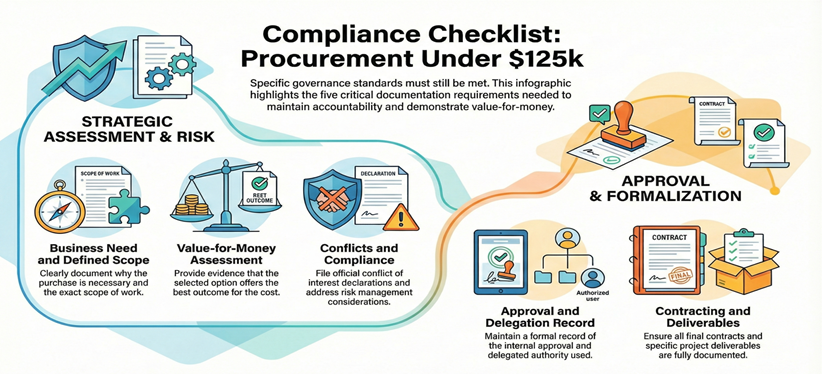
5. Risk and Compliance Considerations
Agencies should conduct a simple risk assessment to ensure engagement complies with regulations.
Documentation should confirm:
6. Approval and Delegation Record
Financial delegations and approval pathways should be clearly documented.
This includes:
Clear approval records reduce the likelihood of later questions.
7. Contracting and deliverables
Irrespective of whether the procurement is under $125K, the engagement should be appropriately formalised.
The agreement should outline:
If expectations are unclear, even small engagements can lead to conflict.
When all of these elements are documented consistently, then procurement under $125K becomes both efficient and defensible.
The next step is to ensure these controls are applied in a way that supports fast-delivery.
Uncertainty around the procurement process can often lead to delays. Procurement at this level doesn’t need to be complex. The process is relatively straightforward.
Prior to entering the market, a clear scope should be defined. This ensures that quotes are comparable and reduces the risk of scope creep once the engagement is underway.
From there, the sourcing approach should reflect the nature of the work. For lower-value engagements, an existing panel arrangement or a limited quotation process is sufficient. If suppliers are engaged directly, the rationale should be documented.
Once a supplier is selected, the focus should shift to the why. A concise value-for-money explanation, conflict of interest declarations, and any relevant risk considerations are necessary to record. This strengthens defensibility without adding unnecessary complexity.
Finally, approvals should be confirmed under the appropriate delegation and formalised through a contract or work order that clearly outlines expectations and payment terms.
Although the updated Commonwealth Procurement Rules threshold should streamline procurement, there are certain circumstances that require an additional level of care (or a more structured approach). Repeated supplier engagement is one such example. Unless an SME is engaged to continue a project or for specialist capabilities, repeated use of the same supplier can raise questions about fairness and competitive tension.
Another area to watch out for is how the work is structured. When related pieces of work are split across multiple agreements to remain under the threshold, the total value may need to be considered. Even if this occurs unintentionally, it can draw attention and lead to questioning.
The risk profile should also shape the approach. A high-sensitivity engagement, for example, involving personal information or operational risk, may require additional controls or more detailed documentation.
Finally, although there is often pressure to move fast, agencies must always fulfill the procurement pathway requirements, demonstrating value for money, transparency, and appropriate decision-making. When these are in place, procurement can move faster without creating issues later on.
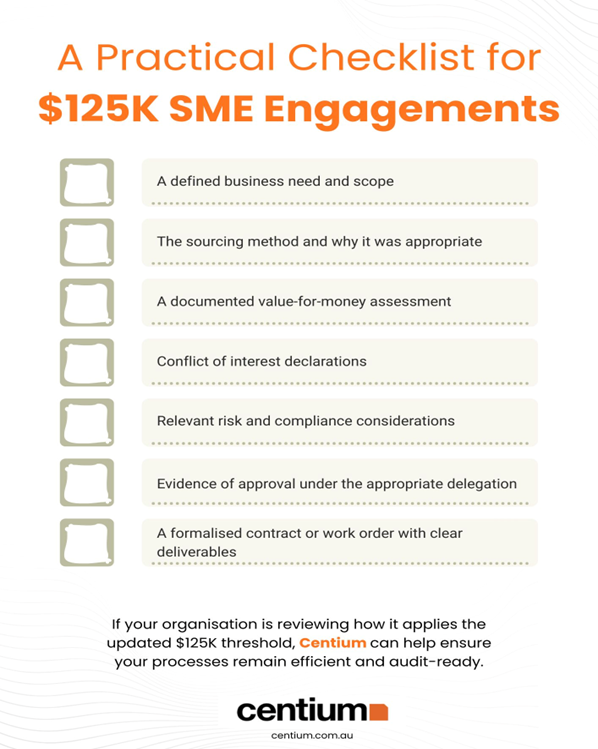
Before finalising an engagement, organisations should confirm that the procurement file clearly demonstrates:
If these elements are present, the engagement is more likely to be compliant while avoiding unnecessary work later down the track.
When used correctly, the $125K threshold allows government entities to engage more quickly while reducing paperwork. For SMEs, it lowers some of the administrative burden that can make it difficult to compete, opening more doors for specialist providers to contribute.
However, the benefits of the updated procurement rules are only realised when applied correctly and consistently.
This is where strong governance capability is important.
How Centium can Assist
Centium is a 100% Australian-owned SME prequalified on the MAS panel.
Centium supports government entities across Australia in strengthening procurement governance, improving documentation practices, and providing independent probity and assurance services.
As a supplier on the Commonwealth Management Advisory Services (MAS) Panel,Centium can be engaged through established procurement pathways, making it easier for agencies to access specialist governance and probity support. If your organisation is reviewing how it applies the updated $125K CPRS threshold, Centium can help ensure your processes remain efficient and audit-ready. Reach out to our expert advisers today.
